Previewing IEPs and Printing Individual Pages

Minor revisions or amendments to student IEPs will often create the need to print a single page of a student’s IEP.  The print menu allows you to select individual pages of a student’s IEP, but you will need to know which page contains the content you are looking for.
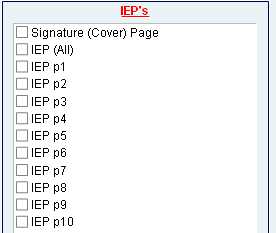
Snapshot of IEP print screen


Because every student’s PLAAFP is different, each IEP is a different length.  One student’s “Program Modifications & Accommodations” may appear on page 3, while a different student’s may print on page 5. To avoid printing extra pages, you can preview a printed version of the IEP first, to be sure you are printing the correct page.

1. Select the student record that you wish to print, and click on the “Preview IEP” tab at the top of the screen:

Snapshot of IEP Database Tabs


2. When the preview of the IEP comes up, use the rolodex arrows in the upper left hand corner to scroll through the individual pages of the IEP:

Snapshot of IEP database Rolodex


3. Once you’ve located the page you need, hit ‘ENTER’ on your keyboard, or click the blue “Continue” button: Snapshot of "Continue" button

 

4. The database will then prompt you with a series of popup windows:

Print this IEP? (hit Cancel)
Print Assessment Participation Page? (hit Cancel)
Preview Additional Comments Page? (hit Cancel)
Preview Goals and Objectives? (hit Cancel)

5.  The database will take you back to the Print Menu.  Use the checkboxes to select the individual IEP page(s) that you wish to print, and hit the “Print Selected Forms” button.

Snapshot of "Print Selected Forms" button


New Assessment Field: Not Subject to Testing

We have added a new checkbox to the assessment participation section of the IEP database: “Not subject to assessment due to age or having passed the HSGQE.”

This checkbox should be used for students who are not of testing age (grades PS-2) or for students who have already passed the HSGQE and are no longer subject to state testing.  This field can also be used for Alternate Assessment students in grades 11, 12 or 12+

Snapshot of Assessment Participation section of IEP database

More Collaborative IEP Meetings this Year!

In the spirit of collaborative, amicable and efficient IEP meetings (and the new part of the sped teacher evaluation), here are some tips. “IEP team leaders need to run their meetings in a way that gives everyone an equal opportunity to participate in and understand the proceedings. [They] also need to foster a climate of respect and trust,” Eric Hartwig, administrator of pupil services for Marathon County Schools, Wisconsin.


1. Don’t tolerate personal attacks. School staff and parents can be demeaning or confrontational when they are angry or frustrated. For example, a parent may turn a discussion about the child’s speech/language services into a discussion about whether the provider is qualified. Personal attacks against parents are most likely to be critiques of their parenting skills. Always intervene and shift the conversation back to the student’s needs. Realize that it is permissible to call for a break if a staff member or a parent needs to be spoken with one-to-one.

2. Don’t allow parents to pick and choose. “There should never be an IEP that says, ‘We didn’t do this because the parents didn’t want it,’” said Hartwig. “If the child needs something, you have to find a way to get it to him.”

3. Do summarize reports, evaluations.  In some meetings, evaluators go on for hours regurgitating every piece of data from a test or evaluation. Parents want to know what the information means for their child in an easy to understand, meaningful way.

4. Do instruct staff on how to talk about disabilities.  Demonstrate professionalism and compassion. Ask that staff avoid any language that may be interpreted as offensive, derogatory, or negative.

5. Don’t let staff members leave during the meeting.  Parents may believe that they don’t have the full attention of all the team members, while team members who miss out on parts of the meetings may not understand why certain decisions were made.

Source: Special Ed Connection®. Copyright 2012 by LRP Publications, P.O. Box 24668, West Palm Beach, FL 33416-4668. All rights reserved. For more information on this or other products published by LRP Publications, please call 1-800-341-7874 or visit our website at www.shoplrp.com/special_ed.html.


Increase Parent Satisfaction with the IEP Process

Take these steps to increase parent satisfaction with IEP process

A recent study found that about 70 percent of parents of students with disabilities are satisfied with the IEP process. The study also identified two groups of parents that reported less satisfaction with the IEP process: parents of students with behavioral challenges and economically disadvantaged. Parents of students with challenging behaviors generally are frustrated with the IEP process when they don’t see dramatic improvement in their child’s behavior. Economically disadvantaged parents may have difficulty finding time to attend IEP meetings or understanding the IEP process. Here are some tips from special ed administrators:

1. Accommodate parents’ busy schedules. Get creative—break up one long meeting into several shorter meetings, suggest a conference call, or propose meeting before the school day starts.

2. Accommodate parents with language barriers. Contact your program coordinator if you think an interpreter is needed at the IEP meeting. Provide a copy of the Notice of Procedural Safeguards and any PWNs in their primary language.

3. Be upfront about how long it may take to modify difficult behavior.  Discuss as a team the problem behaviors to address first, which should be the most disruptive or dangerous behaviors. This way, parents know what the district is focusing on and won’t expect all of the child’s problem behaviors to improve at the same time. Assure parents that you will monitor the student for incremental progress and changes in behavior and notify them of such changes. Explain that the team will reconvene if the child does not respond to interventions after one grading period.

4. Explain IEP process in simple terms.  Language barriers or unfamiliarity with special education can make it difficult for parents to understand complex special ed terminology and acronyms. It is imperative that parents believe there is a staff member who will help them to understand the IEP process. They should be aware of what they should never leave an IEP meeting without and what they should look for in their child’s IEP.

Source: Special Ed Connection®. Copyright 2012 by LRP Publications, P.O. Box 24668, West Palm Beach, FL 33416-4668. All rights reserved. For more information on this or other products published by LRP Publications, please call 1-800-341-7874 or visit our website at www.shoplrp.com/special_ed.html

Welcome Back!

Welcome Back to the 2012—2013 School Year!!

Here’s what’s new and review!

  KPBSD has determined that initial evaluations must be completed within 75 CALENDAR days. 3-year reevaluations must never pass their expiration date. More information on evaluations and timelines to come as the state revises regulations.

  We have to report that secondary transition agencies were invited to transition meetings. EVERY time a transition agency is invited to a meeting they must be included on the meeting invitation.
· If you want to include a transition agency as a service provider in the transition section of a student’s IEP, that agency must have been invited to and attended the IEP meeting and agreed to provide the service. Consent to invite agencies is coming soon too!

 ESER —> IEP:  The educational needs statements on the ESER need to be listed in priority order and must relate to all areas identified through the evaluation. (For more information, see September FAQs)