Accommodations & Modifications & Interventions, Oh My!

I have used those words interchangeably for years! Aren’t they the same thing? In reality, our students require a great deal more accommodations than they do modifications. With accommodations, we are not changing our learning expectations for the students—they are expected to learn what the other students are learning—rather we are providing more access to that learning for them by making some adjustments to the environment. And interventions are another thing altogether!

Here’s a break down:

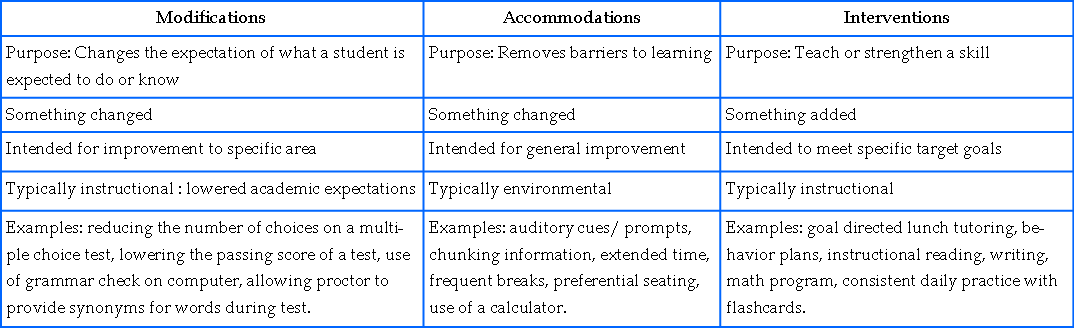
 Modifications are the changing, lowering or reducing of learning and assessment expectations. This includes allowing a student to learn less material than is expected of other students (reducing the number of items on an assignment or the common “shortened assignments”) or revising assignments or tests to make them easier (reminding student of their reading strategies right before testing reading).  Modifications may be appropriate during instruction. If they are necessary during large-scale assessments, such as the HSGQE, pre-approval must be obtained from the state.

 Accommodations are practices and procedures in the areas of presentation, response, setting, or timing/scheduling that provide equitable instructional and assessment access for students with disabilities.

 An Intervention is something that is added to your existing instructional strategies to teach new skills, build fluency in a skill, or encourage a child to apply an existing skill to new situations or settings. Interventions are good educational practice.
ModsAccomsInterv

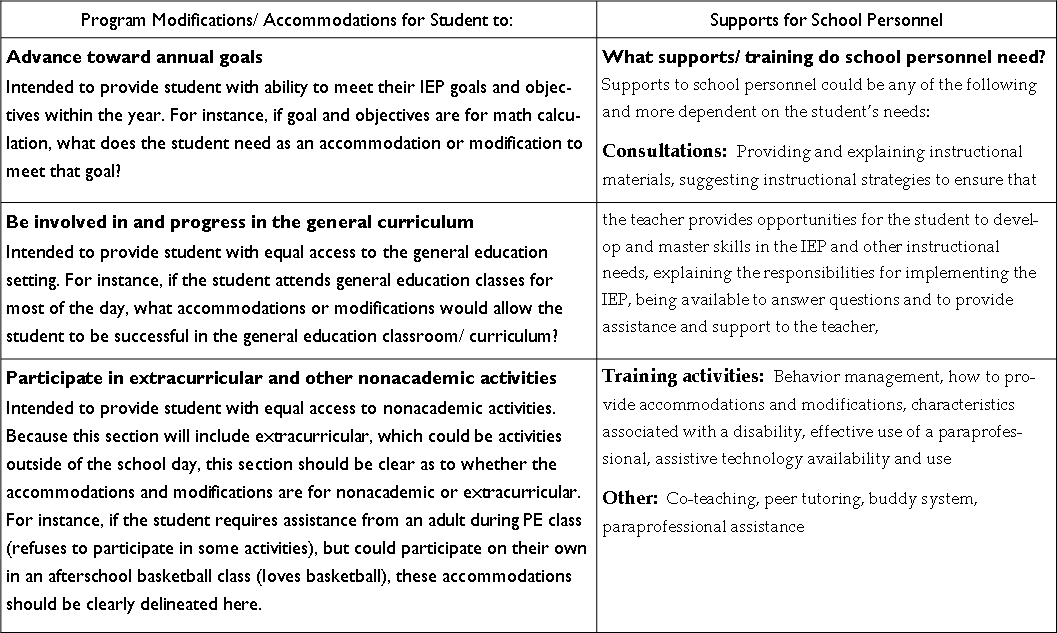
Our IEP forms include the following section for modifications and accommodations:
ModsAccomsInterv2

Thanks to Dan Kaasa, Jill Ramponi and Staci Gonzales for the information provided in this article.

Other websites for intervention help:
www.interventioncentral.org
www.gosbr.net/reading
www.studentprogress.org

November 2012 FAQs


Q: I am using the Edmark program to teach reading to some of my students. Can I include the name of the program in the goals and objectives?
A: It is not best practice to include the names of specific programs in the goals and objectives for the students, but rather a general description or title of the program. For instance, for Edmark, you could say, “a sight word/ functional word based reading program.” In the PLAAFP and in the baseline for the goals, you can state where the student currently is in regards to the programs in which he/she is working. Including names of programs locks the teacher into a particular program, and if the student were to move, would lock another school into a particular program (or providing an explanation of why that program will not be used).

Back to Top

Q: I have an IEP annual and a 3-year reevaluation due in the same year, but we did not hold the meetings together. Any thoughts?
A: The most important thing to remember is that our Special Education Database holds only the most recent IEP paperwork. Once new information is inputted, the previous is deleted. Because of that, it is imperative that you plan ahead.  When an annual and a 3-year are done in the same year, but not at the same meeting (for instance, two weeks apart), you will need to send the paperwork into district office for the first meeting, BEFORE the next meeting is started so that it can be reviewed and corrected, if needed, before it is erased with the paperwork for the subsequent meeting.

Back to Top

Q: A student just transferred from Connections to my school. The IEP doesn’t make sense to be able to implement at my school. Now what?
A: When a student transfers from Connections, primarily with a consult-model IEP, the receiving school will need to amend the IEP to be able to implement the IEP at their school. This includes an amendment to the summary of services and possibly the goals and objectives to be implemented at the receiving school. Always feel free to contact the Connections special ed teacher if you have questions about the student.

Back to Top

Q: I usually send paperwork home to parents at the same time I send it to district office. It is embarrassing to have to contact the parent to correct mistakes found by district office. What can I do?
A:  The hard copy of the IEP is the legal document that the school is to follow and is the educational record for both the district and the parent. Therefore, that document must not only reflect the decisions made by the team for the student, but must reflect our best work as school district employees. Always print out the IEP and proofread it. You may consider asking a colleague to proofread it for you. You may also wish to contact the district office secretaries or your program coordinator prior to printing and sending the document anywhere, and we will be happy to proofread it for you! Proofreading should be for typos as well as for content inconsistencies or errors.

Back to Top

More Math!

Here are some more websites that you may find useful for teaching math as well as professional development for yourself!

http://map.mathshell.org/materials/index.php – Grades 6th through High School. Provides comprehensive unit lessons aligned for both content standards and standards for mathematical practice. Some lessons are focused on developing math concepts, others on non-routine problem solving. There are also professional development modules that help teachers with pedagogical challenges of teaching mathematical practices, as well as formative assessment. Funded by the Bill and Melinda Gates Foundation.

http://blog.mrmeyer.com/  and  www.ted.com/talks/dan_meyer_math_curriculum_makeover.html   – Dan Meyers uses videos that he films and posts to vimeo to generate engaging and challenging real world math problems. Explore his 3-Act math strategy for teaching and his suggestions to improve math text book problems. His teaching is great for Middle and High School. However, there are teacher sites that have used his strategies with 4th and 5th grade as well.

http://www.purplemath.com  –    This site is good to develop content knowledge for algebra. It provides lessons that include techniques for learning, common mistakes, likely “trick” questions, and cross-references to help you find related material.

If you find some additional sites, please let us know!

Special thanks to friends and colleagues: Heidi Jenkins, Sandy Czajkowski, and Alison Place for the sites listed here!!


Seminar Review: Autism, Asperger’s, Sensory & ADHD

Autism, Asperger’s, Sensory, & ADHD
Presented by Gary M. Eisenberg, Ph.D.

Summit Professional Education hosted an Anchorage seminar at the Marriot Hotel featuring Gary M. Eisenberg, Ph.D., a practicing clinical psychologist who has worked directly with children and adolescents with developmental disorders for over 28 years.

Eisenberg reviewed many standard and long practiced interventions shown to be effective with the disorders covered in the seminar. Many of the strategies discussed are used regularly by professionals in our district i. e. ABA, Floortime, TEACCH, Relationship Development Intervention, and Social Skills Training, etc. These effective, researched- based approaches were related to the cerebral cortex as either top down (concept driven and learner directed-needs understanding) or bottom up (foundational skills that are stimulus-driven and therapist directed) behavior therapies. Some of the strategies for teachers with students who have autism/Asperger’s included:  more visual, less verbal; speak slowly in order to facilitate auditory processing; have consistent structure and expectations between home and school; embrace student’s fixations, but set limits; use video modeling; minimize transitions and maintain consistent daily routine; avoid surprises.

Dr. Eisenberg also offered suggestions for kids with attention deficit problems. Aside from the various diets, he suggested that music can and does have a profound calming effect. Another suggestion was for the teachers to “stagger” the tasks sequentially from “easy to hard and then easy.” Finally, he really emphasized the use of visuals for kids with ADHD. He also noted a couple interesting facts. If a kid has a learning disability, the probability of that kid having ADHD is 60%. Classroom tips include: using highlighters, having kids stand, rotate kids through stations every 15 minutes., increase natural and full spectrum lighting, and have them chew gum to increase blood circulation in the frontal lobe of the brain.

Our session was predominantly attended by SLPs and OT/PTs with only a handful of Psyches and SpEd teachers in the group. There were many stimulating questions and thoughtful comments made by attendees throughout the seminar and we all received a certificate upon completion along with an opportunity to purchase a copy of Eisenberg’s work, Recommendations for Treating, Teaching, and Parenting Behavior-Disordered Children. This seminar correlated many of the similarities in effective interventions that work across multiple disorders in a concise and direct way.

   —-Mitchell Pioch & Peter Gundunas, Skyview High School, May 2, 2012


The Focus is Math

For almost all of our schools, SBA scores in math need to be raised—the pressure is mounting. Pupil Services is looking at how to support special education teachers with curriculum and other resources. Hopefully this information is helpful!

www.learner.org—free website from the Annenberg Foundation. Provides professional resources for all academic areas.

www.khanacademy.org—free website for many academic areas, including math, from basic computation to calculus. Provides video explanations as well as practice problems for each of the areas.

www.sosmath.com—free website for practice problems from Algebra to differential equations

According to the Council for Exceptional Children’s math webinar series last school year, we need to use language to move student learning from one level to the next. Ways to increase these language interactions in math class include:

 Allow students to interact frequently with the class materials and concepts

 Model and encourage level appropriate math vocabulary in class dialogue

 Use white boards to assess step by step processes

 Set up cooperative groups with systematic interactions

 Use journals to practice student think alouds and conceptualization

Thank you for all of your work with math (and everything else) for our students!