October 2012 FAQs

Q: I have received IEPs from other schools that are difficult to understand. The PLAAFP has information from four years ago and the font is so small. Is there anything that can be done about that?
A: IEPs must be updated annually and contain the most recent information. The information must be typed to be legible to all, especially parents. Case managers are recommended to use as concise language as possible so that everything fits where it belongs within the IEP.

Back to Top

Q: What should I write in the PLAAFP under “Parent comments/ concerns…”?
A: This section of the PLAAFP is for the parents’ words regarding their children. This should be what parents say they want for their child. Some examples include: “Parents work with Johnny at home. They are concerned that he takes 3 hours to complete his homework,” or “Johnny’s parents were not able to attend the meeting. When setting up the meeting, Johnny’s parents expressed they would like the team to discuss accommodations to allow him to be successful in his general ed math class.”

Some non-examples include: “Parents did not attend the IEP meeting,” or “None at this time.”

Back to Top

Q: What was the deal with the post-secondary transition agency consent?
A: To the greatest extent appropriate, transition agencies must be invited to IEP meetings for students age 16 and older. The regulations say that the parents (adult student) must consent to these agencies’ participation. Some schools have found that the parents will consent to one agency’s participation (e.g. Frontier Community Services), but not to another’s (e.g. DVR). Therefore, we have created a space on the IEP cover page that allows the case manager or the parent to list the agencies they consent to and those they do not prior to signing the consent.

Back to Top

Q: Why don’t I have an OK next to one of my students in the database? I turned in the paperwork already.
A: In order to prevent IEPs at the beginning of the school year going over timeline, case managers need to review their caseloads and hold the annual review for students whose IEPs will expire within the month of August prior to the May 9 paperwork deadline. Therefore, if the IEP that you completed within the month of August 2012 does not have an OK, it is to remind you that you will need to complete the annual review before May 9, 2013.

Back to Top

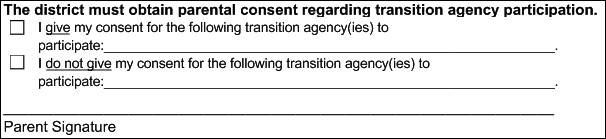
Transition IEP Cover Page – Consent for Outside Agency Participation

The following text has been added to the IEP cover page for transition age students:

The district must obtain parental consent regarding transition agency participation.  (Checkbox) I give my consent for the following agenc(ies) to participate. (Checkbox) I do not give my consent for the following transition agenc(ies) to participate.

At  Friday’s transition training, the question came up as to how to document consent for students with more than one outside agency involved in the transition process. In some instances the family may wish to include one agency and not another. This new text will allow case managers to document which agencies the parent gives consent for participation, and which (if any) the parent does not provide consent for.

The text below has also been added to the printed meeting invite for transition age students:

Note: Districts must invite transition agenc(ies), as appropriate, if a student is at transition age.  Please notify your child's case manager as soon as possible if you do not wish for the transition agency to participate in the meeting.


Please keep in mind that if an outside agency is included in a student’s transition plan, that agency should be invited to participate in the IEP meeting and must be included on the meeting invite. If the parent (or 18 y.o. student) chooses not to give consent for agency participation, we have met our obligation by inviting the agency.  Either way, the parent (student) needs to sign the consent section of the IEP cover page to indicate that they do or do not give consent.  Please use caution when including outside agencies as the provider for transition services if/when those agencies are not active participants in the IEP meeting.


Welcome Back!

Welcome Back to the 2012—2013 School Year!!

Here’s what’s new and review!

  KPBSD has determined that initial evaluations must be completed within 75 CALENDAR days. 3-year reevaluations must never pass their expiration date. More information on evaluations and timelines to come as the state revises regulations.

  We have to report that secondary transition agencies were invited to transition meetings. EVERY time a transition agency is invited to a meeting they must be included on the meeting invitation.
· If you want to include a transition agency as a service provider in the transition section of a student’s IEP, that agency must have been invited to and attended the IEP meeting and agreed to provide the service. Consent to invite agencies is coming soon too!

 ESER —> IEP:  The educational needs statements on the ESER need to be listed in priority order and must relate to all areas identified through the evaluation. (For more information, see September FAQs)


Sample Exit Form for Graduating Seniors

For case managers with graduating seniors, an Exit Form including a “Summary of academic achievement and functional performance” and “Recommendations on assisting the student in meeting post-secondary goals” is required for any student who will be graduating with a regular diploma.  Attached are several examples.

This form can be completed on the database (Go To –> Program Exit Form).

A few examples of the types of statements that should be included on this form are listed below:

“Provide a summary of student’s academic achievement and functional performance, including recommendations on how to assist the student in meeting post-secondary goals.”


 EXAMPLE 1:
Summary of academic achievement and functional performance:

Student struggles with spelling, sentence syntax and organization of his assignments. On lengthy assignments, Student needs extra time to have an adult edit his work. Student’s learning disability in written expression limits his ability to complete lengthy written assignments in a timely manner. Student needs several opportunities for peer proofreading and revision of his written work.

Recommendations on assisting the student in meeting post-secondary goals:

Academic curriculum may need to be modified in content areas to accommodate writing levels. Such accommodations may include: shortened assignments, small group testing environment, clarification of directions on lengthy assignments, a word bank to be provided to Student on all fill in the blank tests, and the use of notes and/or book on tests or quizzes. Student would also benefit from his lengthy writing assignments being segmented into smaller chunks.


 EXAMPLE 2:

Summary of academic achievement and functional performance:

Student has met all of the requirements to earn a diploma from High School: he passed all portions of the High School Graduation Qualifying Exam; he earned the necessary credits; and he completed his senior service project. Student is very respectful. He has perseverance to work through difficult times in order to finally succeed. His ability to communicate clearly has improved. He has also become a better self-advocate.

Recommendations on assisting the student in meeting post-secondary goals:

Student works best in a small setting with minimal distractions. He works best when given clear guidelines and expectations. Student has difficulty communicating his thoughts in an organized manner, both when speaking and when writing. He is sometimes slow to build relationships with adults, but once he does he is able to open up and communicate in a more clear manner. Student responds really well to positive reinforcement and direct feedback.


 EXAMPLE 3:

Summary of academic achievement and functional performance:

Student needs extra time to process information. Once she grasps a concept, she does a good job of holding onto the information. Student needs additional support and time in the small class setting based on her needs in the area of reading comprehension, writing (grammar and vocabulary) and understanding math vocabulary. She has a relative strength in her receptive language, with significant delays in her expressive communication. Student works very hard to compensate for these deficiencies.

Recommendations on assisting the student in meeting post-secondary goals:

Academic curriculum may need to be modified. Such accommodations may include; additional time, directions clarified, use of scientific calculator to check daily work and tests, restate directions, use of visuals, use of vocabulary/concepts graphic organizers, written work edited before turning in, use of math resource guide for daily work and tests, clarification of tests questions

What’s New? – Project Search

What’s New at Your Neighborhood School?

Project Search

Have you heard? KPBSD is looking forward to being the fourth Project Search site in the state! With the support and guidance of the Governor’s Council on Disabilities, KPBSD has begun the initial steps in developing vocational internships with our local business partner, Central Peninsula Hospital (CPH).

Project Search is a secondary transition program for students ages 18-22 with special needs. KPBSD and CPH will place students in internships in the hospital for one year. Students will experience three different jobs while gaining employability and job specific skills. The ultimate goal for the end of the year is for these students to be ready to compete in our community’s competitive job market!

KPBSD has committed a teacher position to this project. That teacher’s classroom will be at CPH. The curriculum will be furnished by Project Search. Interns are still students of the district and must attend daily, and IEPs continue to be in effect.

Though the plan for the 2012-2013 school year is to begin Project Search in the Central Peninsula, transition activities are occurring across our district. Preparing for post-secondary transition is an exciting time for students and teachers. Project Search is just one opportunity on our district’s continuum for transition. For more information about Project Search, please contact Denise Kelly!