What if Students Don’t Want Accommodations?

When students refuse to accept their accommodations, we become concerned that we are not fully implementing their plans. Here are some tips from the LRP Special Ed Connection newsletter.

  1. Document student’s refusal of accommodations. In one school district, teachers document refusals on an “accommodation review worksheet” (sample available at www.montgomeryschoolsmd.org/departments/forms/pdf/270-2c.pdf ). This allows teachers to weigh in on accommodations that are effective or those that may no longer be needed.
  2. It’s the district’s duty to provide accommodations.  Do not blame the student or the parents for not implementing accommodations. Don’t adopt the attitude of, “I’ll leave the notes out for him, but if he doesn’t take them, he doesn’t take them.” If the student rejects an accommodation, the team should determine the issue and try to resolve it. Self-advocacy is important, but it doesn’t mean “that you put the student completely in charge.” Provide and encourage the student to use the accommodations.
  3. Gain buy – in from the student. Consider asking students: why are you rejecting the accommodations? Do you think they help you in the classroom? Are you embarrassed to use your accommodations? How can we help?

Ensure teachers understand accommodations.  For example, a student with preferential seating may not only need to be seated in front, but always near instruction. If a teacher tends to walk around while instructing, she will need to stay in the front

Notes from ASSEC

For the remaining issues of the school year, we will be featuring learning from educators that attended ASSEC! Please send your learning to Denise Kelly (who reserves the right to edit to fit in the space allotted).

Ron Glodoski was a keynote speaker at ASSEC. He spoke of the critical importance of developing relationships with students – especially the ones that drive us crazy! His personal experiences included school avoidance, gang membership, drug use and dealing, criminal activity, prison, and ultimately therapy, the road to recovery, and development of self – esteem. He urged the audience to be that one person who is there for the difficult students unconditionally. Be the one who keeps coming back to help even when they don’t want help.

His student activity workbook, “How to be a Successful Criminal: The Real Deal on Crime, Drugs and Easy Money,” (it’s a “reverse psychology” type of title!) is available at the district office. Contact Rebecca Stilchen – Jaime, and she can bizhub you the entire notebook or make you a hard copy at no cost to you.

For more information, check out
http://www.ronglodoski.com/bookstore.html

If you use the activity workbook, let us know what you think!

Using Blogs for Writers

“For students with LD who may struggle with generalization, blog writing offers an experiential environment that does not have to be translated to the “real world” – it is real.” (Jones, 2012)

Blogs are web sites that reflect an author’s informal thoughts on topics of their own personal interest. They may have one author or many and most will invite comments from readers. Classroom blogs can offer several benefits for writing instruction. They create an authentic audience for writing. Because blogs have a real audience, they change the purpose of the writing from finishing an assignment to communicating a message. Some may no longer be concerned about the grade they will receive, but rather will write until they believe they can be understood.

Research is limited regarding blogging and students with Learning Disabilities. Studies available suggest that authentic audiences can increase the writing output and achievement of diverse groups of learners, including those with LD.

Studies also suggest that blogs can facilitate authentic writing, increase writing output, and improve writing quality. There are specific things that special educators can do to facilitate student success in blogging.

1. Choose a blog platform based on students’ needs and available resources.
2. Create a writing community.
3. Create meaningful writing assignments.
4. Use evidence-based prewriting strategies.
5. Support online composition with assistive technology.
6. Teach students to create and respond to comments.
7. Maintain, evaluate and tweak the blogging experience for long – term success.

Here are some FREE blog platforms for you and your students to explore:

Google Blogger www.blogger.com

Word Press www.wordpress.com
(KPBSD has an internal server set up through this website that allows any district employee to set up a blog by going to: http://blogs.kpbsd.k12.ak.us

Edublogs (specific to educators and students) http://edublogs.org

KPBSD Resource www.kpbsd.k12.ak.us/employees.aspx?id=11230

Jones, S.R. (November/December 2012). Digital Access: Using Blogs to Support Adolescent
Writers with Learning Disabilities. Teaching Exceptional Children, 16-23.

Accommodations & Modifications & Interventions, Oh My!

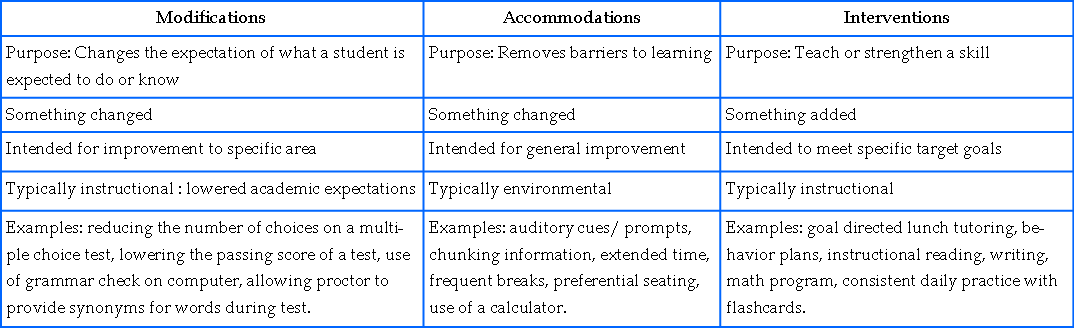
I have used those words interchangeably for years! Aren’t they the same thing? In reality, our students require a great deal more accommodations than they do modifications. With accommodations, we are not changing our learning expectations for the students—they are expected to learn what the other students are learning—rather we are providing more access to that learning for them by making some adjustments to the environment. And interventions are another thing altogether!

Here’s a break down:

 Modifications are the changing, lowering or reducing of learning and assessment expectations. This includes allowing a student to learn less material than is expected of other students (reducing the number of items on an assignment or the common “shortened assignments”) or revising assignments or tests to make them easier (reminding student of their reading strategies right before testing reading).  Modifications may be appropriate during instruction. If they are necessary during large-scale assessments, such as the HSGQE, pre-approval must be obtained from the state.

 Accommodations are practices and procedures in the areas of presentation, response, setting, or timing/scheduling that provide equitable instructional and assessment access for students with disabilities.

 An Intervention is something that is added to your existing instructional strategies to teach new skills, build fluency in a skill, or encourage a child to apply an existing skill to new situations or settings. Interventions are good educational practice.

ModsAccomsInterv

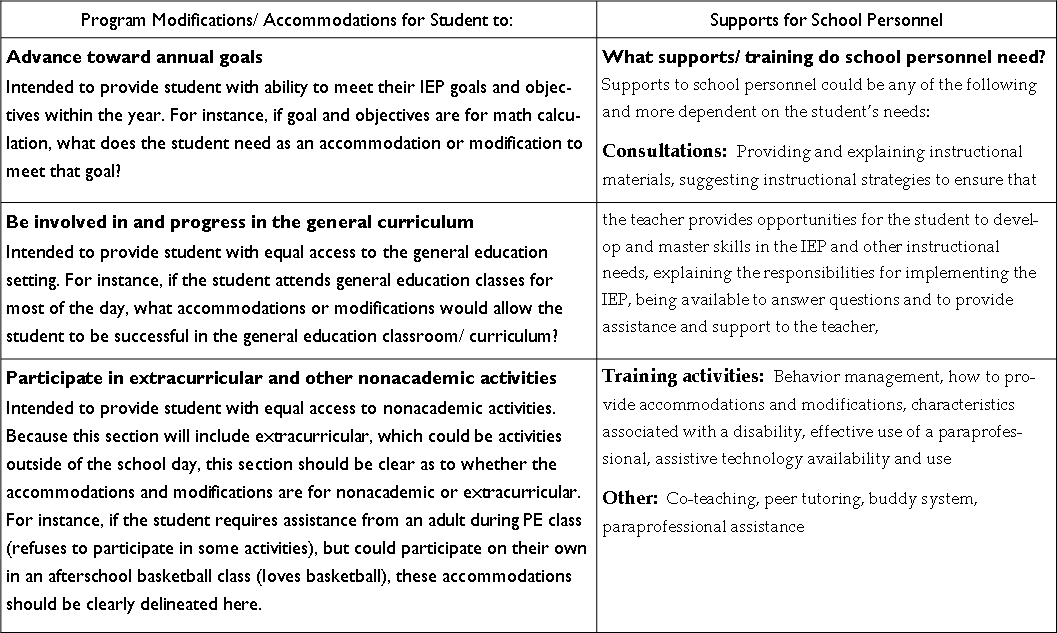
Our IEP forms include the following section for modifications and accommodations:

ModsAccomsInterv2

Thanks to Dan Kaasa, Jill Ramponi and Staci Gonzales for the information provided in this article.

Other websites for intervention help:
www.interventioncentral.org
www.gosbr.net/reading
www.studentprogress.org

Common Views and Myths about Bullying

 Myth: Telling a teacher about bullying is tattling.   Fact: Children need to know the difference between tattling and telling. Tattling is done to get someone in trouble, telling is done to protect someone. The secrecy of bullying only serves to protect the bully and perpetuate the behavior.

  Myth:  It’s only teasing.  Fact:  Most children are occasionally teased. When teasing does not hurt a child, it isn’t considered bullying. Teasing becomes bullying when a child does not understand that he or she is being teased and the intent of the action is to hurt or harm.

  Myth:  Bullied kids need to learn how to deal with bullying on their own. Fact:  Some children have confidence and skills to stop bullying when it happens, but many do not. Moreover, children shouldn’t be expected to deal with bullying on their own. Bullying is a form of victimization and peer abuse. Just as society does not expect victims of other types of abuse to “deal with the situation on their own,” we should not expect this from targets of bullying.

  Myth:  Bullying is easy to recognize.  Fact:  Physical bullying, such as hitting, kicking, and fighting, is easy to recognize since this type of behavior is overt. It is the covert bullying—such as shunning, alienating, and leaving children out on purpose—that is much harder to detect.

  Myth:  Girls don’t bully.  Fact:  Research shows that girls can and do bully. While they do not physically bully targets as often as boys, they will often use verbal and emotional bullying. Bullying for girls escalates during the middle school years.

From Pacer Center, as shared by Stone Soup Group Bullying Prevention Presentation at Soldotna Elementary School October 25, 2012.